
Grasstrees of southwestern Australia
Notes prepared by Distinguished Prof Emeritus Byron Lamont, June 2023, updated May 2026
3 genera: Xanthorrhoea preissii (10 spp), Kingia australis, Dasypogon hookeri
What is their growth form and when do grasstrees grow?
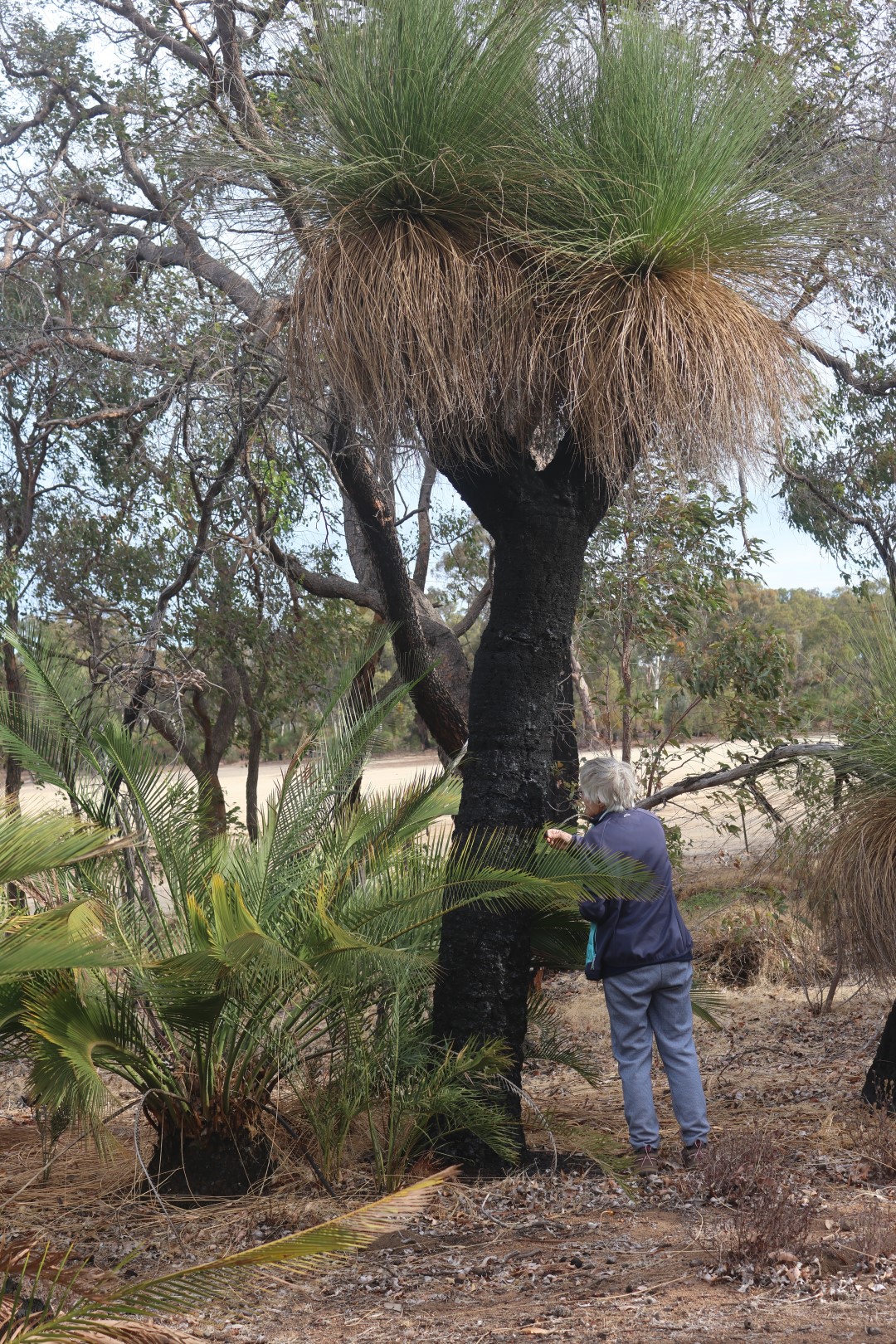
Xanthorrhoea: usually single stemmed (caudex) but may dichotomize after flowering, tallest: 6.5 m, oldest: 400 y, most crown heads: 23, largest plants in Augusta, grow continuously, peaking in summer, 500 leaves/y, die after 2 y
How do grasstrees survive summer drought?
Leaves: xero/scleromorphic, resin blocks xylem in green, burnt leaves, sunken stomata
Caudex: persistent leaves, resin
Roots: renewed from edge annually and can reach a depth > 2 m, instant response to summer water
How fast do grasstrees grow?
5-40 mm/y, average 15 mm/y, depends on growing conditions, double horizontal growth bands detectable from leaf bases and caudex
How do grasstrees respond to fire?
Highly fire tolerant as adults, foliage burns at >1000C but apex <60C. 85% of foliage consumed, most nitrogen and sulfur lost, half calcium and potassium and 40% phosphorus, flush of new leaves immediately, intercalary growth, nutrient uptake (uptake from ash).
Fire-stimulated (pyrogenic) flowering of grasstrees
Apex converted to reproductive bud (sympodial growth), inflorescence: spike + scape, replaces 250 leaves, carbon from stored starch, and sugars from leaves and inflorescence itself, plants lacking caudex rarely flower, 75% do once 1.5 m tall, size of inflorescence independent of size of plant, optimal flowering and fruit set (in spring) from summer fire, negligible with winter fire. Rate of inflorescence elongation?
Evolution of Xanthorrhoea
Originated in Australia 60 million years ago (Xanthorrhoideae), nearest relatives in the Mediterranean and South Africa (Asphodeloideae), entire group with pyrogenic flowering arose 70 Ma, other related families well represented in SWA indicating that group fire-prone from 75 Ma.
What causes burnt grasstrees to flower?
Smoke – ethylene, exhaust fumes?
What can the ageing methods tell us about the fire history of the vegetation?
Use of the caudex method in the Darling range indicates grasstree flowered/burned at 6-7 y intervals during 1810-1920 and at 12 y intervals during 1920-1980. Secondary growth engulfs earlier evidence. Forest Dept formed 1920 with fire suppression policy, then prescribed burning from 1954. The leafbase method gives 3 and 8 y intervals. Leafbase method seems to overestimate fire occurrences near base of the tree (reveals deeper peaks not due to fire). Both methods appear to overestimate the incidence of fires more generally but both indicate declining fire frequency.
Importance of grasstrees for animals (including humans)
Pollination: wide range of insects; birds and possums rare – effectiveness unknown
Borers in spike distort and kill growing spike – moth (Meyriccia latro)
Seeds eaten by parrots, survive 2 y, germinate readily
Bardies, palack, witjuti grubs in decaying caudex – jewel, longicorn and scarab beetles most common (www.anthropologyfromtheshed.com)
How is Kingia different from Xanthorrhoea?
Tallest 8 m (probably taller exist), oldest: 510 y, no secondary growth, sheath of aerial roots descend from apex taking 50 or more years to reach soil, laterals among leaf bases – efficient nutrient absorption from there (more nutrients than soil). Crown of drumstick inflorescences after fire (fit for a king?), monopodial growth, flowers within a month of fire as floral primordia already exist, similar growth rate, similar fire history to Xanthorrhoea but more fitful, 1-2 m tall before will flower but some flowering in absence of fire, caudex pith may survive for 400 y.
Participants in various grasstree projects from 1977 to 2017
Byron Lamont (Convenor and lead author of 7 of 18 papers produced from the work, now Distinguished Prof Emeritus); David Ward (now PhD, retired from DBCA); Dylan Korczynskyj (now PhD, Assoc Professor at Notre Dame University, Fremantle); Roy Witkuhn (now PhD, environmental consultant); Perry Swanborough (already had PhD, fate unknown); Susan Downes (left botany to become a general practitioner, now retired – excellent artist); Chantelle Burrows (topic of Honours project, was employed by DBCA but current situation unknown); Wendy Colangelo (was histologist on project and returned to medical research part-time); Jennifer Eldridge, Carrie Fordham, Emily Clements (topics of Third year projects, and fate unknown); Scores of students undertaking my unit, Flowering Plants 201, where fieldwork was part of the Course; Matthew Lamont field assistant (now social worker).
Thanks to Dr Philip Groom who penned the cartoons used in this lecture.
Publications produced on grasstrees by Byron Lamont and colleagues
Lamont, B.B. and Downes, S. 1979. The flowering and fire history of the grass trees Xanthorrhoea preissii and Kingia australis. Journal of Applied Ecology 16, 893-899.
Lamont, BB 1980. Tissue longevity of the arborescent monocotyledon, Kingia australis (Xanthorrhoeaceae). American Journal of Botany 67, 1262-1264.
Lamont, B. 1981. Morphometrics of the aerial roots of Kingia australis (Liliales). Australian Journal of Botany 29, 10-25.
Lamont, B. 1981. Availability of water and inorganic nutrients in the persistent leaf bases of the grass tree Kingia australis and the uptake and translocation of labelled phosphate by the embedded aerial roots. Physiologia Plantarum 52, 181-186.
Lamont, B.B., Swanborough, P. and Ward, D. 2000. Plant size and season of burn affect flowering and fruiting of the grasstree, Xanthorrhoea preissii. Austral Ecology 25, 268-272.
Lamont, B., Burrows, C., Colangelo, W., Swanborough, P. and Ward, D. 1999. Grasstrees (Xanthorrhoea spp.) and the fire history of sites. Bushfire 99 Conference Proceedings, Albury, NSW. pp. 213-218.
Ward, D. and Lamont, B.B., Swanborough, P. 2000. Probability of grasstrees (Xanthorrhoea preissii) flowering after fire. Journal of the Royal Society of Western Australia 83, 13-16.
Wittkuhn R.S. and Lamont B.B. 2002. Have Australian species evolved characteristics that make them more flammable? an example using a grasstree that retains dead leaves. 2nd Joint Meeting of the Ecological Society of Australia and the New Zealand Ecological Society, Cairns, 1-6 December 2002, p 171.
Colangelo, W.I., Lamont, B.B., Jones, A.S, Ward, D.J and Bombardieri, S. 2002. The anatomy and chemistry of the colour bands of grasstree stems (Xanthorrhoea preissii) as a basis for plant age and fire history determination. Annals of Botany 89, 605-611.
Swanborough, P.W., Lamont. B.B. and February, E.C. 2003. d13C and water-use efficiency in Australian grasstrees and South African conifers over the last century. Oecologia 136, 205-212.
Lamont, B.B., Ward, D.F., Eldridge, J., Korczynskyj, D, Colangelo, W.I., Fordham, C., Clements, E. and Wittkuhn, R. 2003. Believing the Balga: a new method for gauging the fire history of vegetation using grasstrees. In: Abbott, I. and Burrows, N. (eds) Fire in South-west Australian Ecosystems: Impacts and Management. Backhuys, Leiden, the Netherlands. pp. 146-169.
Koch, J.M., Richardson, R. and Lamont, B.B. 2004. Grazing by kangaroos limits the establishment of the grasstrees Xanthorrhoea gracilis and X. preissii in restored bauxite mines in eucalypt forest of southwestern Australia. Restoration Ecology 12, 297-305.
Korczynskyj, D. and Lamont, B.B. 2005. Grasstree (Xanthorrhoea preissii) leaf growth in relation to season and water availability. Austral Ecology 30, 765-774.
Korczynskyj, D. and Lamont, B.B. 2005. Grasstree (Xanthorrhoea preissii) recovery after fire in two seasons and habitats. Australian Journal of Botany 53, 509-515.
Groeneveld, J., Enright, NJ and Lamont, BB 2008. Simulating the effects of different spatio-temporal fire regimes on plant metapopulation persistence in a Mediterranean-type region. Journal of Applied Ecology 45: 1477–1485.
Miller, BP, Walshe, T, Enright, NJ and Lamont, BB 2012. Grasstree stem analysis reveals insufficient data for inference of fire history. Journal of the Royal Society of Western Australia 95: 95–102.
Wittkuhn, RS, Lamont, BB and He, T 2017. Combustion temperatures and nutrient transfers when grasstrees burn. Fire Ecology and Management 399, 179-187.
Lamont, B., Weinert, A., & Duff, H. (2025) Novel root clusters in the grasstree Kingia australis (Dasypogonaceae) increase the root surface/volume ratio by 70 times. Australian Journal of Botany 73, BT25022. doi:10.1071/BT25022. Paper accompanied by the following note from the editors: “The Editors-in Chief wish to acknowledge Byron Lamont’s long-term contribution to the journal. This is his 28th paper to have been published in the Australian Journal of Botany (the first occurring 53 years ago!). Ironically, the first paper was also about specialised roots in the SW Australian flora. Byron’s contribution to the journal has also included serving on the editorial board between 1993 and 1996.”
Lamont, BB and Groom, PK (2026) Heavy road traffic promotes flowering of the grasstree, Xanthorrhoea preissii – a preliminary investigation. Preprint: https://doi.org/10.21203/rs.3.rs-9616542/v1


We use cookies to improve your experience on our site. By using our site, you consent to cookies.
Manage your cookie preferences below:
Essential cookies enable basic functions and are necessary for the proper function of the website.
These cookies are used for managing login functionality on this website.
Statistics cookies collect information anonymously. This information helps us understand how visitors use our website.
Google Analytics is a powerful tool that tracks and analyzes website traffic for informed marketing decisions.
Service URL: policies.google.com (opens in a new window)